Carbon Footprint of a Cheeseburger
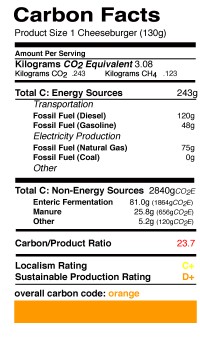
Ever wonder how those carbon footprint calculations get made? You know, "I saved ten pounds of carbon by washing my car with cold water." Jamais Cascio, father of uber-Viridian site, worldchanging, opens the hood and shows the work on calculating the carbon footprint of a cheeseburger.
Burgers are common food items for most people in the US -- surprisingly common. Estimates for the average American diet range from an average of about one per week, or about 50/year (Fast Food Nation) to as many as three burgers per week, or roughly 150/year (the Economist, among other sources). So what's the global warming impact of all those cheeseburgers? I don't just mean cooking the burger; I mean the gamut of energy costs associated with a hamburger -- including growing the feed for the cattle for beef and cheese, growing the produce, storing and transporting the components, as well as cooking.
The first step in answering this question requires figuring out the life cycle energy of a cheeseburger, and it turns out we're in luck. Energy Use in the Food Sector (PDF), a 2000 report from Stockholm University and the Swiss Federal Institute of Technology, does just that. This highly-detailed report covers the myriad elements going into the production of the components of a burger, from growing and milling the wheat to make bread, to feeding, slaughtering and freezing the cattle for meat -- even the energy costs of pickling cucumbers. The report is fascinating in its own right, but it also gives us exactly what we need to make a relatively decent estimation of the carbon footprint of a burger.
The researchers break this down by process, but not by energy type. Here, then, is a first approximation: we can split the food production and transportation uses into a diesel category, and the food processing (milling, cooking, storage) uses into an electricity category. Split this way, the totals add up thusly:
Diesel -- 4.7 to 10.8 MJ per burger
Electricity -- 2.6 to 8.4 MJ per burger
With these ranges in hand, we can then convert the energy use into carbon dioxide emissions, based on fuel. Diesel is straightforward. For electricity, we should calculate the footprint using both natural gas and coal, as their carbon emissions vary considerably. (If you're lucky enough to have your local cattle ranches, farms and burger joints powered by wind farm, you can drop that part of the footprint entirely.) The results:
Diesel -- 350 to 800 grams of carbon dioxide per burger
Gas -- 416 to 1340 grams of carbon dioxide per burger
Coal -- 676 to 2200 grams of carbon dioxide per burger
...for a combined carbon dioxide footprint of a cheeseburger of 766 grams of CO2 (at the low end, with gas) to 3000 grams of CO2 (at the high end, with coal). Adding in the carbon from operating the restaurant (and driving to the burger shop in the first place), we can reasonably call it somewhere between 1 kilogram and 3.5 kilograms of energy-based carbon dioxide emissions per cheeseburger.
Labels: Climate Change, Energy
posted by -cman- at 5/08/2007 09:45:00 PM


0 Comments:
Post a Comment
<< Home