Monday, May 21, 2007

Al Gore Has Big Plans

I haven't had time to read the entire thing yet but, the NY Times has a big article today on Al Gore and the future of his global warming bandwagon. Al Gore Has Big Plans.

But the core of everything is the three-year program of mass persuasion to be conducted under the aegis of the Alliance for Climate Protection. The alliance will not lobby or even propose specific solutions to global warming; rather, it will seek to break the climate crisis out of the crunchy confines of environmentalism. Global warming is going to have a giant product rollout. Gore talks constantly about the need to move public opinion; he is convinced that what now seem like forbidding political and technical obstacles to drastically reducing carbon emissions will give way once we marshal the will to act. And Gore says he believes that once people understand the science, they’ll share his sense of urgency. Thanks to Hurricane Katrina, and balmy winters, and animals evacuating their habitats, and all those terrifying pictures of melting glaciers, that sense may already be taking hold. According to a recent New York Times/CBS News poll, 78 percent of Americans believe that global warming requires action “right away.


I've said it before, love him or hate him "Ozone Al" is still going to be a major player on the world's stage.

Labels: , ,

Tuesday, May 08, 2007

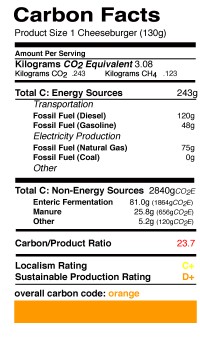
Carbon Footprint of a Cheeseburger


Ever wonder how those carbon footprint calculations get made? You know, "I saved ten pounds of carbon by washing my car with cold water." Jamais Cascio, father of uber-Viridian site, worldchanging, opens the hood and shows the work on calculating the carbon footprint of a cheeseburger.

Burgers are common food items for most people in the US -- surprisingly common. Estimates for the average American diet range from an average of about one per week, or about 50/year (Fast Food Nation) to as many as three burgers per week, or roughly 150/year (the Economist, among other sources). So what's the global warming impact of all those cheeseburgers? I don't just mean cooking the burger; I mean the gamut of energy costs associated with a hamburger -- including growing the feed for the cattle for beef and cheese, growing the produce, storing and transporting the components, as well as cooking.

The first step in answering this question requires figuring out the life cycle energy of a cheeseburger, and it turns out we're in luck. Energy Use in the Food Sector (PDF), a 2000 report from Stockholm University and the Swiss Federal Institute of Technology, does just that. This highly-detailed report covers the myriad elements going into the production of the components of a burger, from growing and milling the wheat to make bread, to feeding, slaughtering and freezing the cattle for meat -- even the energy costs of pickling cucumbers. The report is fascinating in its own right, but it also gives us exactly what we need to make a relatively decent estimation of the carbon footprint of a burger.

The researchers break this down by process, but not by energy type. Here, then, is a first approximation: we can split the food production and transportation uses into a diesel category, and the food processing (milling, cooking, storage) uses into an electricity category. Split this way, the totals add up thusly:

Diesel -- 4.7 to 10.8 MJ per burger
Electricity -- 2.6 to 8.4 MJ per burger

With these ranges in hand, we can then convert the energy use into carbon dioxide emissions, based on fuel. Diesel is straightforward. For electricity, we should calculate the footprint using both natural gas and coal, as their carbon emissions vary considerably. (If you're lucky enough to have your local cattle ranches, farms and burger joints powered by wind farm, you can drop that part of the footprint entirely.) The results:

Diesel -- 350 to 800 grams of carbon dioxide per burger
Gas -- 416 to 1340 grams of carbon dioxide per burger
Coal -- 676 to 2200 grams of carbon dioxide per burger

...for a combined carbon dioxide footprint of a cheeseburger of 766 grams of CO2 (at the low end, with gas) to 3000 grams of CO2 (at the high end, with coal). Adding in the carbon from operating the restaurant (and driving to the burger shop in the first place), we can reasonably call it somewhere between 1 kilogram and 3.5 kilograms of energy-based carbon dioxide emissions per cheeseburger.

Labels: ,

Wednesday, April 25, 2007

Earth Futures

Viridian Pope-Emperor, Bruce Sterling is noted for saying that we have two potential futures to select from, the unimaginable or the unthinkable.

Worldchanging.org co-founder, Jamais Cascio posts this X-Y futures matrix.

Labels: ,

Monday, March 05, 2007

Viridian Pope-Emperor Basks In Glow of Victory

Bruce Sterling, founder of of the Viridian Design Movement gets some ink space in the Washington Post to gloat and bask in the glory of people coming around to our side. My Dot-Green Future Is Finally Arriving:

Back in 1998, the Mexican state of Chiapas caught fire and the smoke from its rainless "rain forests" stretched all the way to Chicago. In Austin, my home town, the sky was the color of a dead television channel. Living under that hideous gout of smoke, I realized that the much-anticipated greenhouse effect was as real as dirt. Most people didn't grasp that at the time. That's okay by me: If everybody got it about issues of that sort, I wouldn't get paid for being a futurist. As it happened, though, five years earlier I'd written a science-fiction novel about climate change. So I was fully briefed.

Wall Street investment tycoon Henry Kravis, the original "Barbarian at the Gate," is buying into Texas coal plants so they won't exist. The great and the good at the World Economic Forum in Davos, Switzerland, were corporate green all the way. Austin has proclaimed itself the world capital of the war on climate change. Britain's Stern Report on the economics of climate change proves that it's cheaper to run a world than to wreck it. The Bulletin of the Atomic Scientists has figured out that a climate crisis is as scary as a nuclear exchange. And there is an absolute explosion of trendy green design Web logs, of which mine, Viridiandesign.org, was one of the first.

They're all about creating irresistible consumer demand for cool objects that will yield a global atmosphere upgrade. It's the Net vs. the 20th-century fossil order in a fight that the cybergreens are winning. Why? Because they're not about spiritual potential, human decency, small is beautiful, peace, justice or anything else unattainable. The cybergreens are about stuff people want, such as health, sex, glamour, hot products, awesome bandwidth, tech innovation and tons of money.

We're gonna glam, spend and consume our way into planetary survival. My own favorite sci-fi planetary-saving scheme for naming, numbering and linking to the Internet every piece of junk we create so that it can be corralled and briskly recycled, creating a cradle-to-cradle postindustrial order and averting planetary doom, may sound pretty shocking and alien. But I wrote that book while in residency at a famous design school. I received an honorary doctorate there and the book was published by the Massachusetts Institute of Technology. It gets great reviews, designers love it. It's not even science fiction -- it's a cybergreen manifesto.

Could I return to my first paragraph for a second? That part about me and the crowd of Serbian radicals? Serbia may be the world's single-greatest locale for a professional futurist. Awful things happen there faster than awful things happen anywhere else. The Balkans is a tragic region that denied stark reality, broke its economy, started multiple unnecessary wars, and basically finger-pointed and squabbled its way into a comprehensive train wreck. It suffered all kinds of pig-headed mayhem, all unnecessary.

That's just how the world behaved with the climate crisis, too. The time for action isn't now. The time for action was 40 years ago. Today we live in a stricken world that bypassed its time for action. We have wreaked science-fiction levels of havoc on the unresisting carcass of Mother Nature. The real trouble is ahead of us.

So what's the good part? They never gave up around here. On the contrary: There's a certain vivid liveliness in the way they're scrambling and clawing their way out of yawning abyss. The food is great, the women dress to kill, and sometimes they even laugh and dance.

Labels: ,

Saturday, March 03, 2007

Saturday Global Warming Linkfest

Off to Chicago this morning at the crack of dawn. Taking the kids to the Art Institute. While I'm gone, depress yourself with a litany of bad global warming news.

Audio from NPR's Science Friday endition of Talk of The Nation on the International Polar year. Scientists talk about how the polar climate is warming far more rapidly than anyone expected.

Warm Winters Upset Rythms of Maple Sugar, NYT.

Bush Administration estimates Emmissions Will Continue To Grow Through 2011.

But there is good news. The Viridian Pope-Emperor wraps it up in the latest Viridian Note.

The Washington Post looks at a big utility buyout through a green business lens, When Being Green Puts You In The Black.

Labels:

Saturday, February 03, 2007

Groundhog's Day

As I sit here the thermometer outside the kitchen window reads -3 F with a brisk wind. Which should serve as a good reminder for everyone that weather is local and short-term and climate is global and long-term. Weather is a highly variable thing subject to extremes while climate is the overall mean temperature. Important to remember as we freeze our asses off.

That said, here is an interesting article from the New York Times that also shows a bit of flair on the part of the headline writer(s): The Groundhog Emerged, and Sounded a Lot Like Al Gore:

Groundhog Day has been part of the Western calendar since around the fifth century, which means it has survived centuries of Catholicism, the Reformation, the Enlightenment, the Industrial Revolution, and the advent of the agriculture of cloned sheep.

But whether it will survive in an age of global warming was one question — albeit not the biggest one — raised by the awkward coincidence yesterday of Groundhog Day 2007 falling on the same day a report was released by the Intergovernmental Panel on Climate Change of the United Nations.

In fact, both “El Niño” and “global warming” appeared in the official forecast read on Phil’s behalf at 7:28 a.m. yesterday by a spokesman for the Punxsutawney Groundhog Club, an organization loosely affiliated with the Chamber of Commerce of Punxsutawney, Pa., whose usual population of 6,000 swells to around 20,000 for the annual announcement.

“El Niño has caused high winds, heavy snow, ice and freezing temperatures in the West,” the four-legged forecaster began his four-couplet decree. “Here in the East with much mild winter weather we have been blessed.

“Global warming has caused a great debate; this mild winter makes it seem just great,” he continued. “On this Groundhog Day we think of one thing. Will we have winter or will we have spring? On Gobbler’s Knob I see no shadow today. I predict that early spring is on the way.”

In its earliest incarnation, Groundhog Day or something like it was a pagan observance, marking the midpoint between the winter and spring solstices, according to historians.

Burrowing animals like the groundhog were said to have the supernatural ability to foretell an early spring. The observance merged at some point with the Christian holiday of Candlemas, and the tradition embodied in this proverb: “If Candlemas be fair and bright, winter will have another fight. If Candlemas brings cloud and rain, winter won’t come again.”

Labels:

Friday, January 19, 2007

Opening Moves Of Carbon Trading Gambit In Congress?

A couple of things have crept up in the last few days that make me think that a serious play for some form of carbon credit and/or trading scheme will come up in this Congress. First, the inside baseball bench moves from My DD's, Nancy Scola:

Pelosi's push this week to create a new Select Committee on Energy Independence and Global Warming was a fascinating peek into the inner-workings of the House and the relationships between the Speaker, Democratic leadership, and the rest of her caucus. Yep, the new panel lacks legislative jurisdiction, but is a platform for raising the profile of climate change. As to be expected, John Dingell -- chairman of the committee that loses ground in this new move and the representative from suburban Detroit -- found this whole reorganization business just simply unnecessary.

Motivating Pelosi? The knowledge that Dingell isn't too keen on the idea that there is a scientific consensus on global warming; the Speaker seems to really want movement on climate change this Congress, and this move puts pressure all around to squeeze something out of the House in the near future.

But oh, there's so much more in this mix! For example: Dingell's chief of staff was a lobbyist and strategist at DaimlerChrysler as late as November. Dingell's wife is the executive director of government relations at GM. Dingell favored Hoyer over Pelosi in the Whip's race in 2001. Pelosi backed Dingell's primary challenger Lynne Rivers in 2002. One House chairman, Henry Waxman is of the opinion that "existing committees can deal effectively with global warming," but worth keeping in mind is that Waxman is next in line for the chair of the Energy and Commerce Committee should the 81 year-old Dingell ever vacate the House.

Just in terms of structure, it's hard not to see this as an end run by Pelosi around the House's committee system and its chairmen. There just doesn't seem to be a whole lot of precedent for what she's done. (Of course, one might argue that there's not a whole lot of precedent for global warming.) The last "non-permanent select committee" was created by Republican leadership to blunt criticism after Hurricane Katrina. The one before that, Homeland Security, was created in the wake of September 11 and soon evolved into full standing committee. This new panel isn't as obviously event-driven and isn't yet designated permanent. Is the idea for it to be short-lived and for climate change and energy independence to revert back to Energy and Commerce when, say, Waxman pries the gavel out of Dingell's hands?


So, that's the House, where Pelosi seems to be laying the groundwork for a committee to talk serious shop about climate change. Over on the Senate, the EIA has just posted a response to a request (largish PDF document) by Sens. Bingaman, Landrieu, Murkowski, Specter, Salazar, and Lugar - a bipartisan lot you'll note -- for comment on draft legislation for a carbon trading regime. In the document, complete with the senators' request and draft legislation.

The draft legislation itself is pretty forward-thinking (at least compared to efforts to-date):

The program would establish annual emissions caps based on targeted reductions in greenhouse gas intensity, defined as emissions per dollar of Gross Domestic Product (GDP). The targeted reduction in GHG intensity would be 2.6 percent annually between 2012 and 2021, then increase to 3.0 percent per year beginning in 2022. To limit its potential cost, the program includes a “safety-valve” provision that allows regulated entities to pay a pre-established emissions fee in lieu of submitting an allowance. The safety-valve price is initially set at $7 (in nominal dollars) per metric ton of carbon dioxide equivalent (MMTCO2e) in 2012 and increases each year by 5 percent over the projected rate of inflation, as measured by the projected increase in the implicit GDP price deflator. In 2004 dollars, the safety valve rises from $5.89 in 2012 to $14.18 in 2030.

The proposal calls for initially allocating 90 percent of the allowances for free to various affected groups, but the proportion of allowances to be auctioned grows from 10 percent in 2012 to 38 percent in 2030. The revenue from the auctions and any safety-valve payments are accumulated into a “Climate Change Trust Fund,” capped at $50 billion, to provide incentives and pay for research, development, and deployment of technologies to reduce greenhouse gas emissions. The U.S. Treasury would retain any revenue collected in excess of the $50-billion limit.


Predictably, the EIA takes a dim view of the proposal. In essence they say that it would shave output in the early part of the program as industries pick the low-hanging fruit from a greenhouse gas (GHG) amelioration standpoint. But says the EUA, after that as gains get harder to come by, they would just pay more into the "saftey-valve" account and pollute away. However, the EIA predictions for future prices don't seem to take into account the increased expenses from either building non-GHG production, or paying the production penalty that the producers will incur and inevitably pass on to consumers.

All of EIA's prognostication abilities must be taken with a large grain of salt, considering for example their inability to predict (see: Natural Gas & Diminished Expectations) US gas production and imports over the last six years, or their utter failure to come to grips with North Sea peak oil.

Not saying that anything that reaches the floor will even remotely resemble the draft. But this at least shows that there are people on both sides of the aisle who are starting to think and -- more to the point -- plan seriously about making intelligent policy with regards to petroleum scarcity and global warming.

Labels: , ,

Wednesday, December 06, 2006

New Orleans is Uninsurable, Part 2

The progressive blogsphere is picking up a story that has not yet caught the attention of the major media. Over at MyDD and
Firedoglake they are lashing out at the decision by St. Paul Travelers Insurance not to renew its commercial insurance policies in New Orleans starting next year. This has stoked fears that St. Paul will be lead a flight by other companies out of New Orleans. This may well be the case.

In previous posts here, Florida Becomes Uninsurable Part 1 and New Orleans is Unisurable, I have discussed at length the price that will have to be paid for global climate change. Although many of the gross macroeconomic and geopolitical effects will not manifest for decades to come, I think that we can consider New Orleans the canary in the coal mine.


Many progressives and liberals insist that the levees be rebuilt; that the insurance companies be forced to insure these areas or that the federal government step in as the insurer of last resort. All of these proposals have their hearts in the right place. And all of them are dead wrong.

The people of New Orleans have been victimized in many ways; victimized by poor levee design, victimized by the devil-take-the-hindmost attitude of the federal government following Katrina. But most of all they are victims of fate, disastrous land use policies, and global climate change. In many ways they are the first to pay the dues for our industrial culture's massive carbon dependency. But they will hardly be the last.

Markets work because when not meddled with too much, they are pretty efficient. The insurance industry is -- despite its other micro-problems -- at the macro level a pretty efficient risk-assessment machine. What St. Paul Traveller's is essentially saying with its actions is: "it is our calculation that given the pace of levee reconstruction combined with the long-term prospects for more severe hurricanes and rising sea levels we cannot find any way to ever turn a profit in this region." That calculation is no doubt made by also looking at southern Louisiana in an aggregate context with other high-risk areas. Southern Louisiana on its own is a huge insurance risk that threatens to drag down policies in other areas that are not as threatened (yet).

As for the questions that are posed in many of the blog posts above such as what will become of the essential businesses in the region, many of which are crucial to our nation's energy and trade infrastructure. The answer is:

The bottom line is that old Mama Nature is going to re-assert her control over the coastlines. It will become economically impossible for people to maintain a presence along those coasts unless they fall into one of the following buckets: a) Individuals or companies wealthy enough to rebuild frequently, b) performing work or conducting business that is profitable enough to place them in Bucket A, c) performing work or conducting business that is unable to be done elsewhere and pass the costs of rebuilding on to customers, or finally d) Building (or re-building as the case may be) one's structures in the mode of Hitler's Atlantic Wall.


Many people I normally agree with say this is a typical case of big business sticking it to the little guy and playing pick-and-choose with regards to class. As blogger Athena puts it:

Look, I know somebody's gonna respond with risk-analysis graphs and such and I get it, I do, but the fact of the matter is that it's past time we stopped with the unconditional surrender in the class warfare that leads to these insurers saying eh, too bad, so sad, see ya later every time people actually need them to do what they exist to do and what you pay them every single month to do….


New Orleans is a tragedy, made worse by the fact that the worst effects were avoidable and FEMA's assistance efforts criminally negligent. The federal government can and should fulfill its commitments to assist people in resettlement or rebuilding. But it would be poor policy indeed to begin to either force insurance companies to carry insurance on property that has a nearly 100% likelihood of being destroyed again within our lifetimes or to saddle the government with the cost and to build the public expectation that when we literally reap the whirlwind of our carbon emissions Big Government will cover our bad bets.

Tragically, the people of Southern Louisiana are but the first to find out that their once enviable real estate is now situated a live-at-your-own-risk zone. But as the picture above says, their fate is ours. A fate that will be shared by millions of Americans and billions of human beings during my lifetime, the lifetime of my children and my children's children. Many of us just haven't come to grips with it yet. But it is high time we did.

It must start by those who live in the at-risk zones realizing that their property is on borrowed time. Sooner or latter the hammer will fall, the seas rise, the crops fail and if you don't have a Plan B you are basically fucked. And yes, I'm quite aware that many billions of people do not have the freedom, resources or other requirements to have an effective Plan B. That is why I'm in the shrill chorus of people who say that global climate change is the number one social, economic, and political problem facing the world today.

Labels: ,

Tuesday, July 18, 2006

Hot Enough For Ya?

Of course here in Iowa we are used to this sort of thing in July and August. But it is hot all over, baby.


According to the National Climactic Data Center the first half of 2006, January through June, was the warmest first half of a year since records began in 1895, with temperatures in North America a whopping 3.4 degrees Fahrenheit above average. The next hottest year? 2005.

Globally, according to NASA, 2005 was the hottest on record, with the top five being filled out by 1998, 2002, 2003, 2004.

Labels:

Monday, May 08, 2006

Florida Becomes Unisurable

Are the Florida Keys the canary in the coal mine for the densely populated Gulf Coast?

As Hurricanes Loom, Many in Florida Keys Flee, by Laura Meyers, Panet Ark, 5/5/2006

KEY WEST, Florida - Spiralling living costs, lingering trauma from past evacuations and fear that one day million-dollar homes could be reduced to rubble or again flooded are driving people out of the vulnerable Florida Keys as another hurricane season looms.

Home prices in the entire Florida Keys average US$846,000, and in Key West, the main city, US$935,000, according to Coldwell Banker Schmitt Real Estate.

The head-turning price of real estate, and limited land for development, also is putting a squeeze on renters as apartments and mom-and-pop motels are converted into condominiums and sold off as second and third homes to wealthy retirees.

"We're gun-shy about going through another hurricane. We gave up on buying a home here in Key West," said Dorothy McCoy, a daycare provider who with her painter husband Denis recently left the Keys.

Keys homeowners also suffer Florida's highest insurance premiums. Citizens Property Insurance, the state-run insurer of last resort, proposed a base windstorm rate of US$20.91 per US$1,000 of insured home value for this year.

Furious Keys officials threatened to sue the state, and a grass-roots organisation, Fair Insurance Rates in Monroe, or FIRM, met with Governor Jeb Bush, brother of US President George W. Bush, in April to seek support.

Florida insurance regulators rejected the rate filing on Monday and Insurance Commissioner Kevin McCarty froze Keys' windstorm rates at the 2005 level of US$20.58 per US$1,000, still the state's highest and two to three times as high as the rates in other hurricane-hit counties.

Key West resident David Lane and his wife Pam recently listed their historic 186-square-metre (2,000-sq-ft) home at US$1.5 million and plan to head to Asheville, North Carolina. Their windstorm insurance premium: US$12,700.

Many residents feel the same way, and the result is a slow exodus from paradise.

The population of Monroe County -- the entire Florida Keys -- dropped 2.16 percent to 76,329 in the year to July 2005. In the last five years, the county's population has shrunk 4.1 percent at a time when most areas in Florida are growing rapidly, according to a US Census report in March.

"These are people who've lived here 20 to 25 years," said John Strong, owner of Pak Mail, a packing and crating franchise. "They're going to Arizona, North Carolina and Central America, seeking no hurricanes."

The problem is acute for teachers, nurses and police officers. An increasing number of Monroe County sheriff's employees commute from Miami. Sheriff Rick Roth is adding 18 bunks at a detention centre which could be used by the commuters in an emergency.

A recent Monroe County School District poll found that 7 percent of families with school-aged children planned to leave when the school year ends in May.

"We can't get nurses, we can't get doctors," said John Dolan-Heitlinger, an advocate for affordable housing for working professionals.

On Big Pine Key, resident Pam Henry said she is struggling to pay US$16,000 a year in property taxes and home insurance, and is moving to central Florida.

"The hurricanes put the icing on the cake," Henry said.


And if that weren't bad enough, this has been one of the dryest winters on record in Florida and officials are fighting some nasty brushfires.

Labels: ,

Saturday, December 10, 2005

New Orleans is Unisurable, Part 1

The Bush Administration is doing the a right thing in the Gulf Coast in denying a $350 million aid request from energy firm, Entergy.
"We believe that transferring federal tax dollars to the bondholders and shareholders of a private firm is inappropriate," said Allan Hubbard,President George W. Bush's top economic adviser who also chairs a White House council on rebuilding the Gulf Coast following Hurricane Katrina

Do tell? Since when? As a puzzled Entergy P.R. flack plaintively pointed out, the U.S. has "made money available to ConEd (the New York utility) after (the attacks of September 11, 2001), the airlines and other private business." I doubt that this move is based upon any sound economic principles but rather the administration knows it would be political suicide to render a third of a billion dollars to an energy company. Especially an energy company that made $963 million in net profit last year.

What is certain is that whatever the administration's motives in snubbing one of its core constituencies and no doubt thereby dooming hundreds of thousands of Louisiana residents to several more months of darkness it is surely not a response to global climate change. But what the administration has done is something that environmental economists and Viridian Greens have been advocating for years.

The principle is essentially this: The world is becoming uninsurable. It is a profound waste of public (and private) money to continue to subsidize a very dense population infrastructure in a region that, even in the best of times, carries a high risk of catastrophic weather. But with the changes in the regional climate of the gulf region the risk index is very high.

Climate change means a more disturbed atmosphere and sea. This means more frequent and stronger storms. With 96 million of the United States' 288 citizens living along the coasts, a tremendous amount of capital is at risk from storms. This fall's hurricane season was merely a harbringer of years to come. While no one is saying that double-hits like Katrina-Wilma on the Gulf will be the norm, the consensus is that tropical storms will be more numerous and stronger such that the likelihood of major storms is much higher.

The insurance industry is taking note. Regional insurers took a big hit after Katrina-Wilma. In the aftermath, stories like this one of the Mississippi Farm Bureau transferring its Katrina claims and refusing to write new storm policies south of Highway 10 became more frequent. The assessment of coastal risk has made its way up the Atlantic coast toeven in Massachusetts, where local insurers are dropping policies on Cape Cod. Finally , this month the call has come from state and local officials to the insurance industry to do a drastic re-think of risk assessment along the coasts. They are worried about their state pension funds going broke in the wake of more huge storms forcing insurance companies into bankruptcy.

The bottom line is that old Mama Nature is going to re-assert her control over the coastlines. It will become economically impossible for people to maintain a presence along those coasts unless they fall into one of the following buckets: A) Individuals or companies wealthy enough to rebuild frequently. B) Performing work or conducting business that is profitable enough to place them in Bucket A. C) Performing work or conducting business that is unable to be done elsewhere and pass the costs of rebuilding on to customers. D) Building one's structures in the mode of Hitler's Atlantic Wall.

Labels: ,

Monday, November 21, 2005

Monday Post and Run

The Independent reports that an article to be published next week in the journal Geophysical Research Letters will show that the melting of the Greenland ice sheets are occurring more rapidly than previously expected. Example: "Helheim glacier, a river of ice that grinds down from the inland ice cap to the sea through a narrow rift in the mountain range on the island's east coast. Professor Slawek Tulaczyk, of the Department of Earth Sciences at the University of California, Santa Cruz, told the IoS that the glacier had dropped 100 feet this summer. Over the past four years, the research adds, the front of the glacier - which has remained in the same place since records began - has retreated four and a half miles." Nice eh?


Ronalihno is the greatest soccer player in the world. Had the good foresight to have Laura tape the Real Madrid - Barcelona game Saturday. Barca went into the Galacticos house and administered a monumental spanking. Ronaldihno's two solo goals on 60 and 30 yard runs were things so sublimely awesome that even Madrid's home fans stood and cheered. 23 shots by the Catalans to Madrid's five. While the result was never really in doubt, this was the most entertaining game of the year. Truly why soccer is the beautiful game.

Oh, and Celtic humiliated Rangers at home 3-0 to put fifteen points between themselves and the men in blue. This victory combined with the money-fueled resurgence of Hearts and and just plain solid play by Hibernian means that there is a very good chance of something happening in Scotland this year that has not happened since 1986: a member of the Old Firm may win the Scottish Football League.

More later if I can squash a few lingering bugs that have been giving me fits.

Labels: ,